
Marcher’s Ordinary Social Life
The Beast in the JungleThis flow follows the respectable routines that conceal Marcher’s inward detachment and reveal how little he participates in ordinary life.
increasing Bearing strength in each event
 decreasing
Bearing strength in each eventdecreasingThe Social Mask

The Social Mask
Respectable Appearances
Marcher maintains a government position, manages his modest property, tends a garden, and accepts social invitations. His manners are considered good, and he appears to function within ordinary society.
Beneath those routines, he experiences himself as detached from the life he performs. The outwardly settled man remains occupied by an expectation no one else can see.
A Divided Existence
May recognizes the gap between Marcher’s social conduct and inward attention. His mask protects his secrecy but also allows him to avoid examining his emotional absence.
Museums and Opera
Museums and Opera
Shared Outings
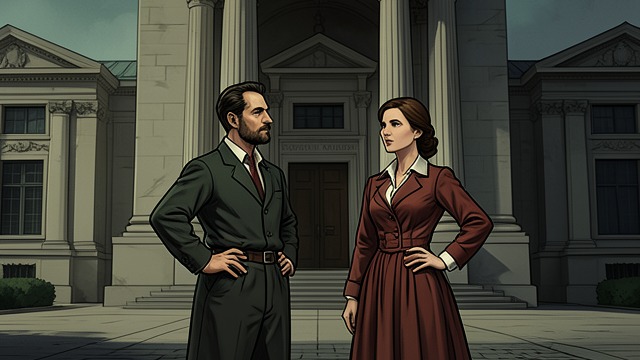
Marcher invites May to museums and the opera, making room for companionship beyond their formal discussions of his fate. These outings give their relationship the appearance of an ordinary friendship.
He sees the invitations as evidence that he is not entirely selfish. His attention to May remains genuine in small ways but does not become a declaration of love.
A Habit of Intimacy
The repeated outings create a daily pattern that brings them close without forcing either to name the emotional imbalance. Society sees an ordinary friendship where May and Marcher share a more complicated private life.
The Birthday Token

The Birthday Token
A Familiar Gift
Marcher brings May a customary birthday present, usually a small and carefully chosen trinket. He takes the gift as proof that he has not become wholly self-absorbed.
The ritual shows that he remembers her habits and wishes to please her. Yet the gesture remains safely within a familiar routine rather than opening a more demanding conversation.
Camouflage and Care
May observes that their habitual companionship helps Marcher pass as an ordinary man. The routine conceals the unusual dependence between them even as it provides real affection.
The Quiet Drawing Room
The Quiet Drawing Room
A Familiar Setting
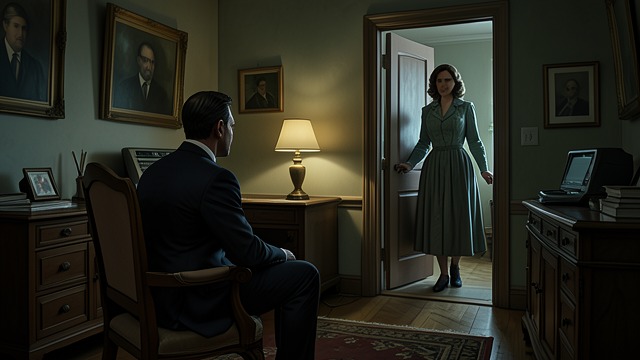
Marcher repeatedly visits May in her drawing room, where their conversations return to the fate they have watched for. The worn setting records years of shared habit and recurring anxiety.
Their topic alternates with ordinary talk, allowing Marcher to regard the relationship as both intimate and socially harmless. The room becomes an enclosure for the life he has not chosen beyond it.
Habit as Concealment
Marcher believes their familiar appearance protects both of them from gossip. He does not see that the routine itself has become a substitute for a fuller life together.
The Mask Falls Away

The Mask Falls Away
A Lack of Recognized Claim
After May dies, Marcher discovers that society does not treat him as her closest relation. Their intimacy has never been publicly defined, leaving him without an acknowledged place among the mourners.
He cannot explain his grief without revealing the private world they shared. The habits that concealed their bond now prevent him from claiming its significance.
Public and Private Loss
Marcher’s social identity offers no language for the depth of his dependence on May. His outward respectability cannot compensate for the relationship he failed to make fully mutual.
Before and after the Weatherend reunion
The first London years after Weatherend
A foggy Sunday during their established friendship
During the later London years
After May’s death
